
Introduction: Why Do We Confuse the Two?
Most people (and even some academic studies) often assume that an entrepreneur is the same as a businessman. However, this misconception limits our understanding of true economic innovation, particularly the distinction between an Entrepreneur vs Businessman.
Are all entrepreneurs businessmen? And if so, are all businessmen entrepreneurs?
The answer lies in their approach to risk, innovation, and the market. What follows is a critical analysis that separates the ‘organizer’ from the ‘innovator’ and explains the powerful nexus that connects them. This is an essential read for anyone navigating their own identity in the world of business.
Understanding the differences between an Entrepreneur vs Businessman can help clarify roles in the business landscape
1. Defining the Businessman: The Manager of Stability
1.1. Historical Roots and Core Focus
Historically, the concept of a businessman began with the commencement of trade, evolving alongside societal development, industrialization, and the rise of capitalism.
The businessman’s primary roles emerged from the need to organize production, maintain supply chains, and manage trading companies. They are generally defined as those engaging in commercial activities.
The core focus of a businessman is:
- Profitability and Sustainability: Ensuring the existing business remains financially healthy.
- Stability over Disruption: They operate primarily within an already existing framework and are more inclined towards market maintenance than disruption.
- Risk Avoidance: A businessman generally tries to avoid innovation and significant risk, prioritizing the protection of existing assets.
- Short-Term Focus: Their primary goal is often maintaining the current market structure and focusing on short-term stability.
2. The Entrepreneur vs Businessman: A Matter of Identity and Innovation
To truly understand the difference between the entrepreneur vs businessman, we must look at the entrepreneur’s identity—which is less about managing and more about changing the game entirely.
2.1. The Entrepreneur’s Dynamic Identity
While historical schools of thought defined the entrepreneur through various lenses—from the person who assumes risk for profit (French school) to the accumulator of capital (English school)—modern analysis focuses on dynamic innovation.
| Feature | Entrepreneur | Businessman |
| Risk | Risk-Taker. Willing to take calculated risks to disrupt the market. | Risk-Averse. Focuses on stability and protecting current assets. |
| Innovation | Innovator. Bothered about creativity to break new ground; searches for change and exploits it. | Maintainer. Operates within the existing market framework. |
| Focus | Seeks opportunities where needs are unmet (gaps) to develop new value. | Manages the existing market conditions and short-term goals. |
| Vision | Long-term vision and strategic planning for the future of the industry. | Short-term focus on maintaining the current market structure. |
“The entrepreneur is one who always searches for change, responds to it, and exploits it as an opportunity”.
Peter Drucker
3. The Nexus: Why the Entrepreneur Must Become the Businessman (EU Focus)
While the distinction between the Entrepreneur vs Businessman is clear, the most impactful careers—especially those dominating the EU market—demonstrate mastery of both roles.
3.1. The Dynamic Innovator: Lessons from Global and European Founders
The ability to be the “dynamic innovator” (the entrepreneur) drives the quest for unparalleled problem-solving and sustainable economic growth. Table 2 summarizes global founders who excelled at this dynamic innovation, featuring key European figures like Richard Branson (UK Founder, Virgin Group), Ingvar Kamprad (IKEA, optimizing global retail supply chains), and Coco Chanel (redefining fashion in Europe).
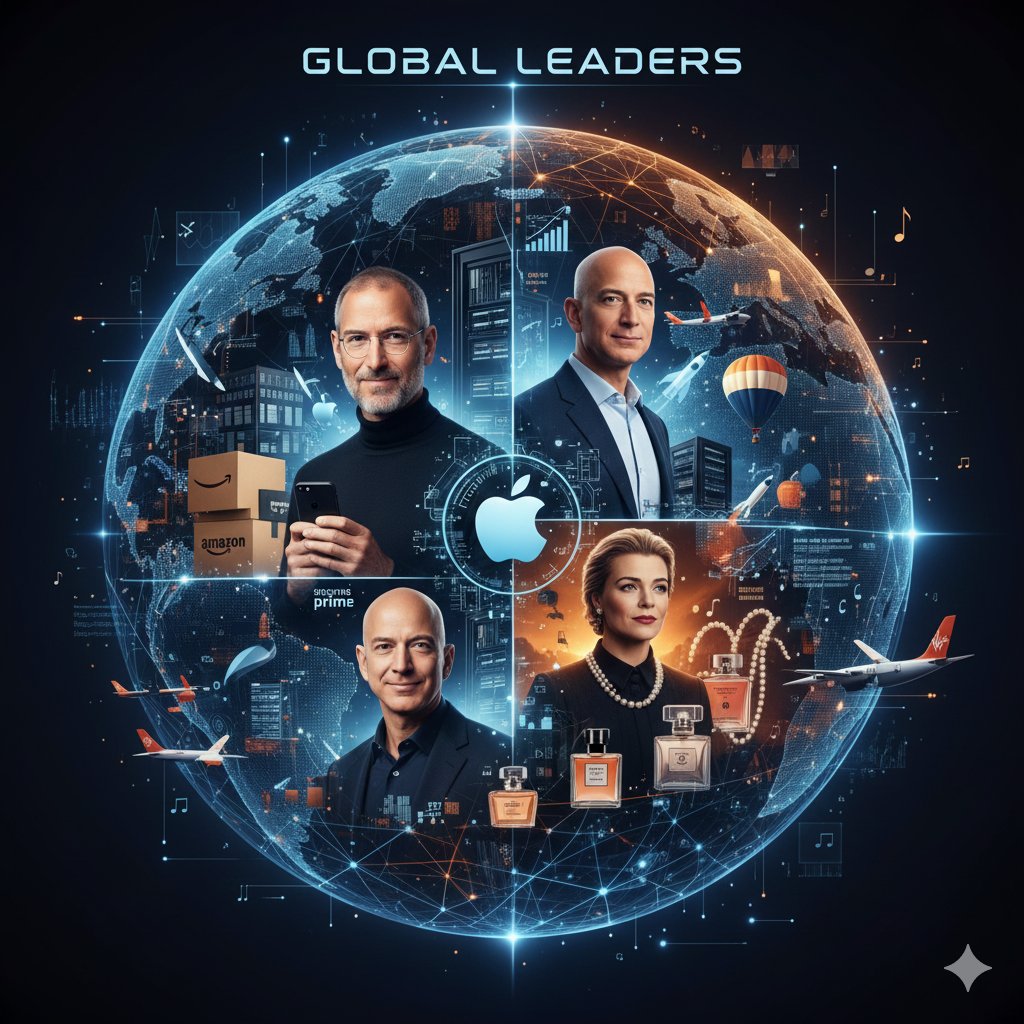
| # | Entrepreneur | Company/Industry | Dynamic Innovation Solution |
| 1 | Steve Jobs | Apple | Introduction of the iPhone, a revolutionary touchscreen smartphone |
| 2 | Bill Gates | Microsoft | Development of the Windows operating system, transforming personal computing |
| 3 | Jeff Bezos | Amazon | Creation of Amazon Web Services (AWS), pioneering cloud computing |
| 4 | Elon Musk | Tesla, SpaceX | Advancement of electric vehicles and reusable space launch systems |
| 5 | Henry Ford | Ford Motor Company | Implementation of the assembly line, revolutionizing automobile production |
| 6 | Richard Branson | Virgin Group | Diversification into multiple industries (music, airlines, space) across the European market and globally |
| 7 | Ingvar Kamprad | IKEA | Introduction of flat-pack furniture, revolutionizing furniture retailing and logistics across Europe |
| 8 | Coco Chanel | Chanel | Introduction of the little black dress, redefining women’s fashion and style across the Eurozone |
Table 2: World’s most successful Entrepreneurs and their dynamic innovative solutions.
4.2. Dapo Abiola, Entrepreneurship and the Hybrid Role
The core lesson for any founder, whether in London, Berlin, or Silicon Valley, is this: The nexus between an Entrepreneur vs Businessman is the ability to incorporate the Entrepreneurial Vision (innovation, creativity, risk-taking) with the Businessman’s Skills (stability, efficiency, resource management).
A pure businessman cannot easily take the entrepreneur’s role because they lack the innovation mindset. However, a successful entrepreneur must deliberately transition to managing operations to scale the business into a sustainable enterprise, especially when dealing with complex EU market regulations and rapid expansion.
The journey of Dapo Abiola, Entrepreneurship—and every successful founder—is defined by mastering this adaptive, hybrid role.
Key Takeaways for Your Identity (Finalized)
- Innovation is the Litmus Test: You are an entrepreneur if your primary concern is creating new value and disrupting the current market. You are a businessman if your primary concern is managing existing value and ensuring stability.
- Embrace the Hybrid: True success requires the initial innovation of the entrepreneur followed by the organizational stability of the businessman.
- European Relevance: Whether pioneering flat-pack furniture (IKEA) or developing revolutionary tech, the principles of balancing dynamic innovation with solid business structure remain universal for success in the EU market.
Navigating the complexities of entrepreneurship requires a nuanced understanding of the distinctions between an entrepreneur and a businessman. While the entrepreneur thrives on innovation and creativity, the businessman is pivotal in operational efficiency and resource management. Mastery of both dimensions fosters hybrid leadership, essential for scaling ventures in today’s competitive landscape. Dapo Abiola’s experience exemplifies how successful founders can integrate these roles, ultimately driving sustained growth amidst evolving market dynamics.
